- Feb 18
Lead Magnet: Turn Your Freebie into a Bridge to Paid Clients
- Chelena Peart
If you have a Lead Magnet tucked away somewhere; a checklist , an ebook, a webinar or a discount code... it’s time to stop treating it like a box to tick and start treating it like the doorway it actually is. A Lead Magnet can be the first impression that either moves someone closer to paying you or quietly lets them drift away. The difference comes down to intention, alignment, and sequencing.
Why your Lead Magnet is not “just a freebie”
A lot of people equate a Lead Magnet with list growth. Yes, it does grow an email list, which matters, but that’s not the main point. The real purpose of a Lead Magnet is positioning. It’s the preview of the transformation you deliver and the experience you want to be known for.
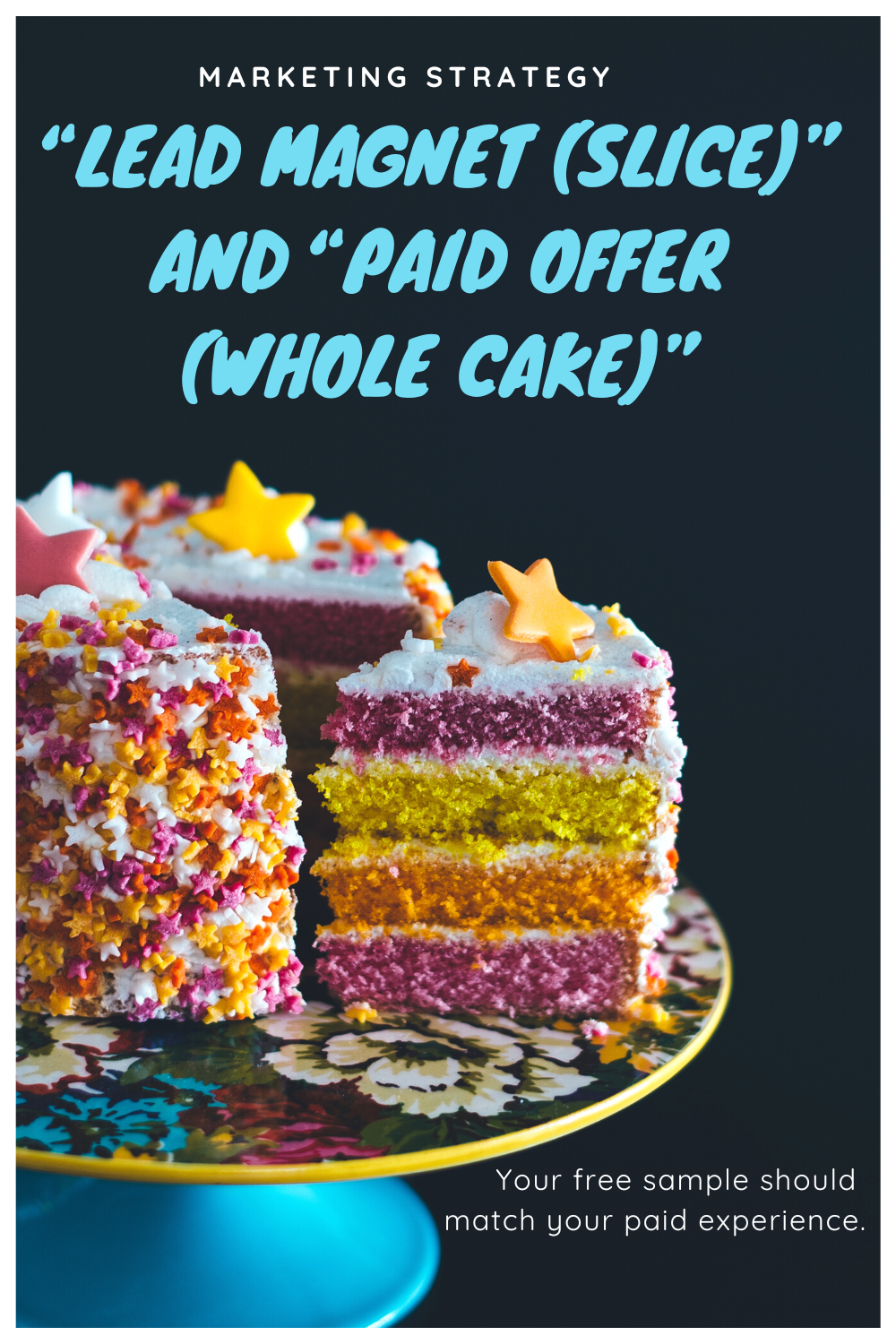
Think of your Lead Magnet as a sliver of the cake you sell. The slice should taste like the whole cake. If the free sample and the paid offering are disjointed, you’ll attract a crowd that likes free samples; not the people you actually want to work with.
Nine practical rules for a Lead Magnet that actually works
Start with the end in mind - design your Lead Magnet backwards from the sale. What problem must people recognise before they will invest in your paid offer? Build a free resource that exposes that problem and gives a quick path toward the kind of result you sell.
Make it a preview of the transformation, not just a list of tips. Your Lead Magnet should demonstrate your approach and give a small, fast win.
Keep it bite-sized and consumable . Long ebooks often sit unread. The quicker someone can get a result, the faster they’ll trust you and be ready to take the next step.
Place the pivot early. Don’t bury the next step at the end of a long PDF or masterclass. If your audience drops off before the offer, the resource fails as a bridge.
Design for alignment - the look and tone should echo your paid work, so people don’t feel like they’ve entered a different universe.
Reverse engineer your funnel. Map the journey: discovery → quick win → decision point → paid offer. Your Lead Magnet sits at the first two steps.
Test who it attracts. If your signups are not potential clients, adjust the problem you solve, the language you use, or where you promote it.
Use it as a qualification tool. Include simple checkpoints or prompts that help a person self-identify whether they need deeper help.
Make the next step irresistible. A low-friction pathway; a short call, an application, a micro-session or a follow-up mini-course, is a better pivot than a vague “learn more” button.
Real-world examples that make the point
A photographer I know (Yes my husband lol) used to offer a mini shoot as part of a consultation. In that ten to fifteen minute shoot prospective couples experienced his style, his calm, and the quality of his edits. That small taste produced a brilliant conversion rate because the sample matched the paid experience.
Contrast that with a pretty, well-designed PDF that gathers lots of downloads but from people who are only window-shopping. I remember I once created a “beautiful” lead magnet that looked great...brilliant branding, strong imagery, and clean layout. Downloads climbed, the email list grew and the client list did not! The resource solved a random, surface-level problem, so the people who signed up weren’t primed to invest in deeper strategy.
How to audit your current Lead Magnet
Use this short checklist to review any Lead Magnet you already have:
Does it align with
your signature offer?
Does it give a clear, quick win for the person who needs your paid service?
Is the next step obvious and easy to take?
Is the content short and actionable rather than being purely informational?
Does the branding and tone match your paid offer?
Are the people downloading likely to become paying clients?
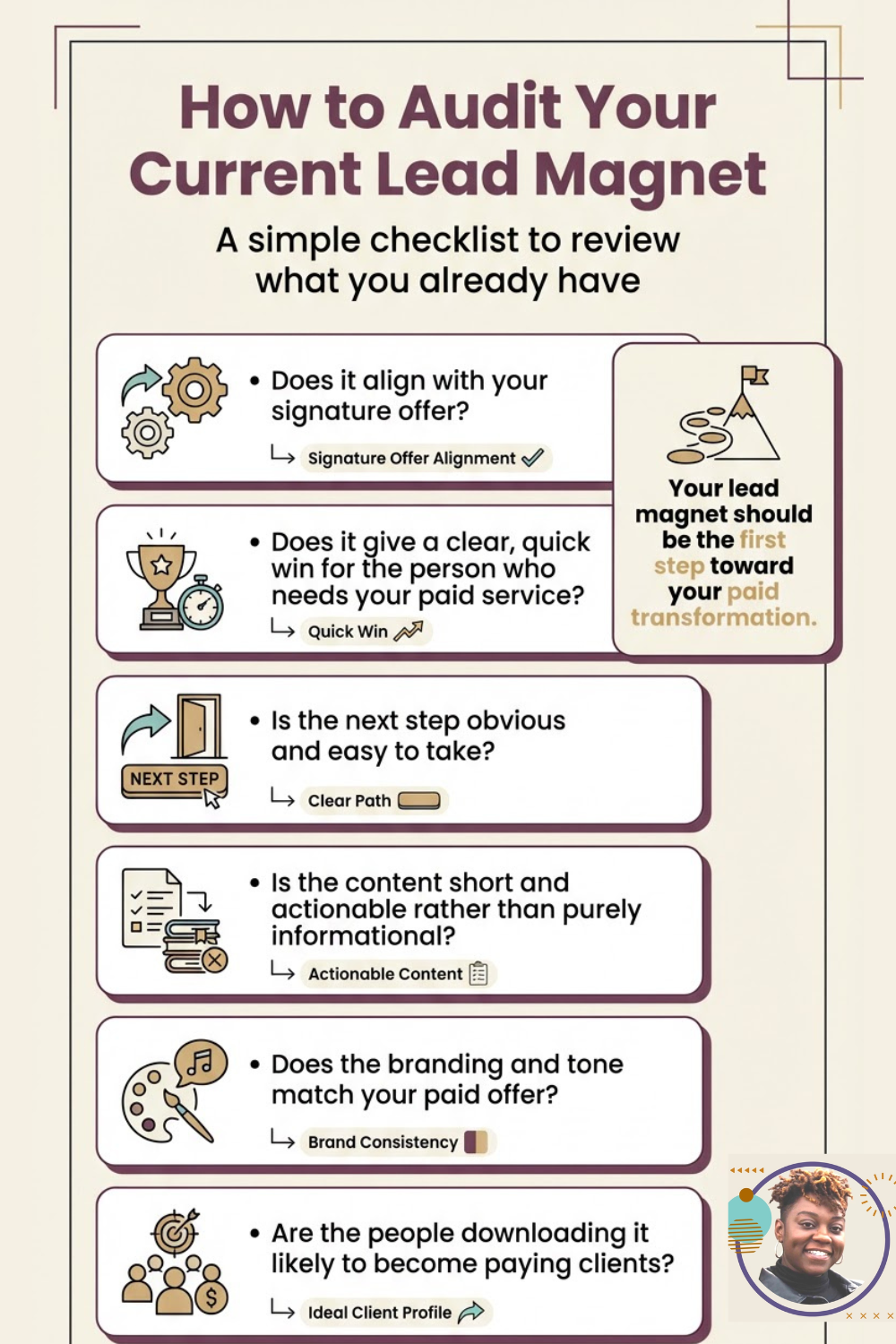
If you answer “no” to more than one of these, it’s time to reshape the resource into a bridge.
Designing a Lead Magnet that builds momentum
Momentum is more valuable than a big but irrelevant list. A Lead Magnet that builds momentum helps you move people along a predictable path. The secret is focusing on one clear outcome that sits one step before your paid offer.
Format choices and when to use them
Quick checklist or template: great when your paid work is process-based and the checklist previews how you will structure the client journey.
Mini masterclass or webinar: useful if your paid offer is a coaching or teaching experience. Keep it short and include an early pivot to the next step.
Micro-session (15–30 minutes): an excellent “try before you buy” technique. It’s experiential and builds trust quickly.
Short workbook: works when your paid offer delivers a step-by-step transformation; use the workbook to reveal the beginning of the roadmap.
Format matters less than alignment. A Lead Magnet can be a checklist or a 45-minute guide, both can work if they deliberately cue the need for deeper support and make the next step feel obvious.
Sequence and messaging: where most people go wrong
The two biggest mistakes are, burying the next step and solving a problem that doesn’t match your paid offer. If you put the pivot at the end of a 25-page PDF, many readers won’t reach it. If your resource teaches a skill that has no link to the premium work you offer, those who sign up won’t be ready to buy.
The fix is simple, put the pivot where people can see it, and weave signposting into the content. A quick line such as “If you want us to do this for you, here’s a three-minute way to get started” can convert more effectively than a polished page that ends with a vague CTA.
How to rework an existing Lead Magnet into a bridge
Identify the exact transformation your paid offer provides, be specific about the outcome.
Edit the lead magnet to highlight one small result that moves someone toward that outcome.
Add a short, visible next step early in the resource; an invitation to a mini-session, short assessment, or an application.
Use qualifying questions within the resource so the reader self-selects as a potential client.
Test and measure, look at conversion from download to next step and from next step to sale.
Language and credibility...don't be the “free value” person
When a Lead Magnet is not aligned, it trains people to see you as the free-value provider. That’s a dangerous pattern; people will expect ongoing freebies rather than investing.
Instead, use the resource to show you are a guide with a method and a pathway to real results. Name the problem clearly, show the quick win, and then explain why deeper work is needed to solve the full problem.
Simple messaging tweaks that increase quality of signups
Replace “Free guide” with “Quick win for [specific audience]” — specificity weeds out non-ideal leads.
Add a short benefit-oriented subtitle: “Get a simple framework to do X in Y days.”
Include a one-line qualifier on the landing page: “This is for people who are ready to move from X to Y.”
Three mini case studies (what to learn from each)
Try-before-you-buy experience : Offers that let prospects experience the service (like a short shoot or sample session) convert at much higher rates because they remove uncertainty.
Pretty but random PDF : Looks excellent, gets downloads, but attracts the wrong people. Lesson: aesthetics alone do not equal conversion.
Short, intentional workbook : Helps the reader to reveal a gap. By the end they realise they need more support; they are warmed up and ready to take the next step.
Track what matters
Focus your metrics on movement, not vanity. Track:
Download to next-step conversion rate
Next-step to paid conversion rate
Percentage of downloads who match your ideal client profile
These numbers tell you whether your Lead Magnet is a bridge or a dead end.
Quick template: a simple bridge-style Lead Magnet
Use this skeleton to build a short resource that points people to the next step.
Title — benefit + audience: “Quick [Result] for [Audience]”
Intro — name the problem in one sentence
Step 1 — a simple action that produces an immediate small win
Mini worksheet — two questions that help self-qualify
Pivot — visible call to action: “If you want help doing this properly, book a 20 minute micro-session”
Common questions about Lead Magnets
What exactly is a Lead Magnet?
A Lead Magnet is a free resource you give in exchange for contact details. More than an email-gathering tool, it is a carefully designed experience that previews the value and method behind your paid work and leads interested people toward a clear next step.
How long should a Lead Magnet be?
Short and actionable. Aim for something that can be consumed and acted upon in 5–30 minutes. If it takes longer than that, break it into a compact version with optional deeper resources.
Can an ebook be effective?
Yes, if it is intentionally structured to preview your approach and includes early, visible signposting to the next step. Avoid long, purely informational ebooks with the pivot hidden at the end.
How do I know if my Lead Magnet attracts the right people?
Track who signs up against your ideal client criteria, then measure how many move to the next step. If conversion is low, tweak the messaging, the problem you solve, or the qualification prompts within the resource.
Should I make it look professional?
Yes, but quality design is not a substitute for alignment. A professional-looking Lead Magnet helps credibility, but it must also clearly lead to your paid work.
What's the pivot I should include?
A low-friction opportunity that brings people one step closer to working with you: micro-sessions, diagnostic calls, short paid trials, or an application for a discovery call .
Final test: is your Lead Magnet a bridge or a dead end?
Ask yourself this single question: where do people go after they access this resource? If they are guided toward the transformation you sell, you have built a bridge. If they stop, skim, or receive more information with no clear pathway, you have created a dead end.
If the result is a dead end, redesign. Reverse engineer from your paid offer, shorten the resource, and bring the pivot forward. The goal is to make the person who downloads your Lead Magnet say, “I want more of this.”
One last thing
The best Lead Magnet is not the one that gets the most downloads. It’s the one that gets the right people to take the next step. Make the change and you will see more momentum, clearer conversations, and fewer wasted hours.
If you want a straightforward way to test this, share your resource with a colleague or trusted advisor and ask them if, after consuming it, they know exactly what to do next and whether they’d pay for more. Their answer will tell you everything.
Join The LinkedIn Strategy Lab
A community of 150+ entrepreneurs focused on using LinkedIn as a lead generating business tool
Book your free discovery call here
FAQ section
Frequently asked questions
You've got questions. We've got answers.
How do profile views impact lead generation on LinkedIn?
Profile views indicate that people are interested in your profile, skills, or services. The more views you get, the higher your chances of attracting potential leads. Optimising your profile ensures that visitors immediately see the value you offer, encouraging them to connect or inquire about your services.
How can I increase my LinkedIn profile views?
To boost profile views:
Optimise your profile with relevant keywords.
Use a professional photo and headline that highlights your expertise.
Engage actively by commenting on posts, sharing insights, and participating in discussions.
Post valuable content consistently to attract more visibility.
Join relevant LinkedIn groups and network with industry peers.
Can LinkedIn Premium improve my lead generation results?
Yes, LinkedIn Premium gives access to:
Advanced Search Filters to find ideal prospects.
More Profile View Insights to see who’s viewing your profile and target them with follow-ups.
InMail Credits for reaching out to decision-makers directly.
Additional Analytics to monitor engagement and refine strategies.